Grass-Fed Tallow vs. Conventional Skincare: An Ingredient Breakdown
What's actually in your moisturizer — and why it matters more than you think.
Let's read some labels together
Pick up any mainstream moisturizer and flip it over. You'll find 20-40 ingredients, most of which you can't pronounce. That's not automatically a problem — complicated names don't mean dangerous ingredients. But it does make it hard to understand what you're actually putting on your skin.
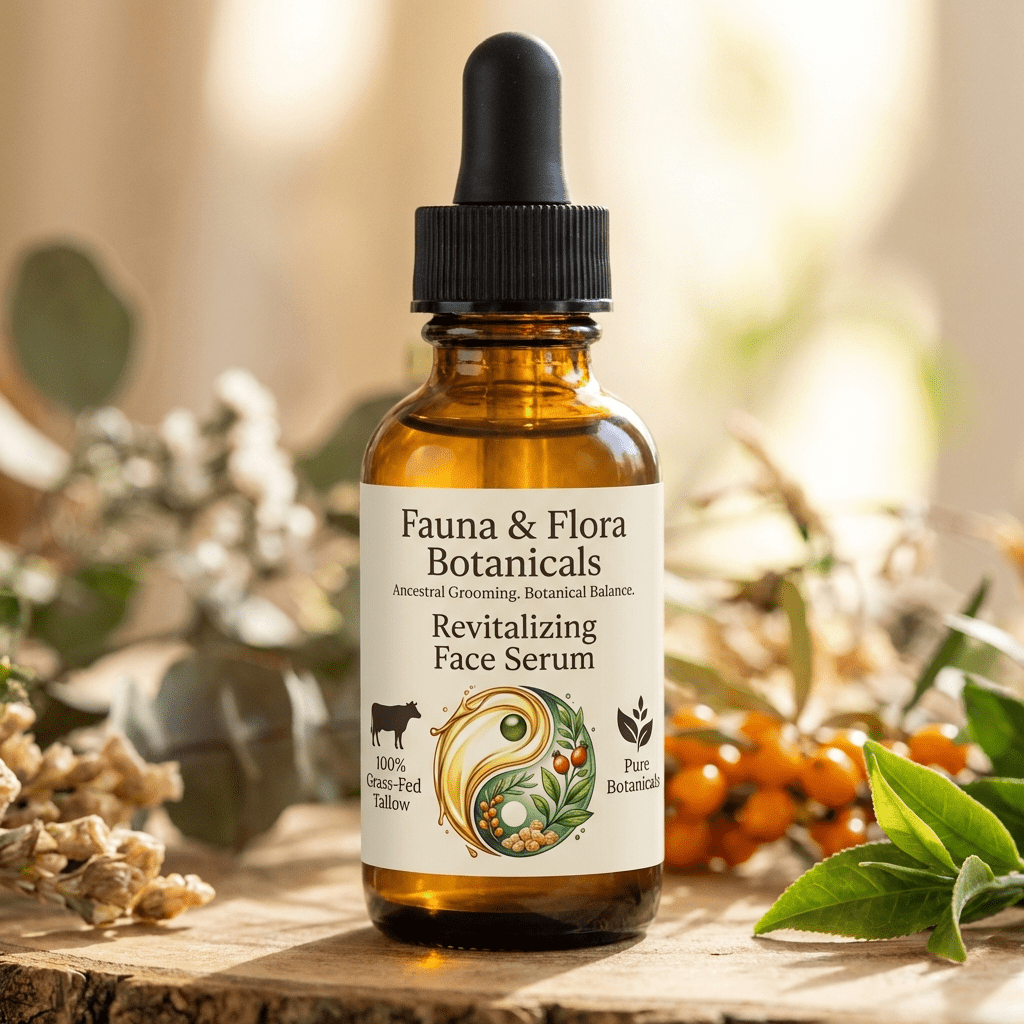
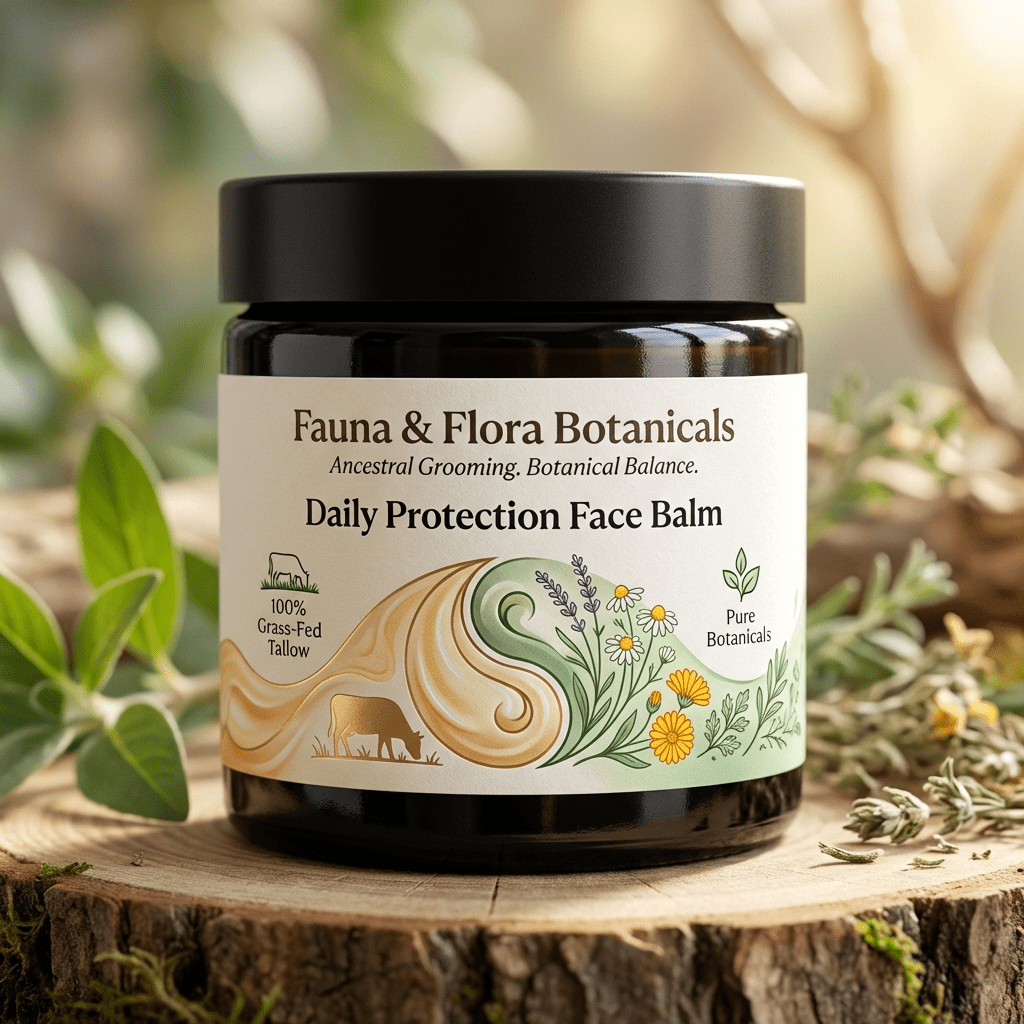
Now look at a tallow-based face balm: Grass-Fed Beef Tallow, Squalane, Rosehip Oil, Frankincense Oil. Four ingredients. Each one does something specific. You can look them all up in about three minutes.
This article isn't about fearmongering. It's about understanding what's in your products and deciding what matters to you.
The typical conventional moisturizer (deconstructed)
Let's break down what you'll commonly find in a mainstream drugstore moisturizer and what each ingredient actually does:
Water (Aqua) — The #1 ingredient in most moisturizers. It's there for texture and spreadability, not hydration. Water on your skin evaporates — it doesn't moisturize. The rest of the formula is essentially trying to prevent that evaporation.
Glycerin — A humectant that draws moisture from the air (or from deeper skin layers) to the surface. Effective in humid environments, less helpful in dry climates where there's less atmospheric moisture to pull from.
Dimethicone — A silicone that creates a smooth, silky feel and forms an occlusive film on the skin. It makes the product feel luxurious on application. The tradeoff: that film can trap sweat, bacteria, and sebum underneath, which some skin types don't tolerate well.
Cetearyl Alcohol — A fatty alcohol used as an emulsifier and thickener. It keeps the oil and water phases blended together. Generally well-tolerated, though some people with sensitive skin react to it.
Fragrance/Parfum — A catch-all term that can represent dozens of undisclosed synthetic compounds. "Fragrance" is considered a trade secret, so companies aren't required to list the individual chemicals. This is the ingredient most commonly associated with skin irritation and allergic reactions.
Methylparaben / Propylparaben — Preservatives that prevent bacterial and fungal growth. Effective at their job, but controversial due to studies showing weak estrogenic activity. The dose makes the poison — at the levels used in skincare, the risk is debated.
Phenoxyethanol — Another preservative, often marketed as a "paraben alternative." Also synthetic, also debated, but currently considered safe at standard concentrations.
A grass-fed tallow face balm (deconstructed)
Now let's break down the same type of product — a face moisturizer — made with tallow:
Grass-Fed Beef Tallow — The base. Contains oleic acid (moisturizing), stearic acid (barrier-reinforcing), palmitic acid (protective), plus fat-soluble vitamins A, D, E, and K. Its fatty acid profile closely matches human sebum, which is why skin absorbs it readily.
Squalane — Derived from olives. Identical to the squalene your skin naturally produces (just hydrogenated for shelf stability). Lightweight, non-comedogenic, and one of the most skin-compatible moisturizing ingredients available.
Rosehip Oil — Cold-pressed from rose hips. High in vitamin C, trans-retinoic acid (a natural form of vitamin A), and essential fatty acids. Supports skin renewal and helps with uneven tone.
Frankincense Oil — Steam-distilled from Boswellia resin. Used in Middle Eastern and North African skincare for thousands of years. Provides a subtle, grounding scent and has a long tradition of use for skin that looks and feels aged.
The comparison, side by side
| Conventional Moisturizer | Tallow Face Balm | |
|---|---|---|
| Ingredient count | 20-40 | 4-6 |
| Base | Water + emulsifiers | Rendered grass-fed tallow |
| Moisturizing mechanism | Humectant (water-attracting) + occlusive film | Lipid integration (mimics sebum) |
| Duration | 2-4 hours before reapplication | 6-12 hours |
| Preservatives needed | Yes (water-based = bacterial risk) | No (anhydrous = shelf-stable) |
| Fragrance | Synthetic (undisclosed compounds) | Essential oils only (or unscented) |
| Silicones | Usually yes | No |
| Skin compatibility | Variable | High (mimics natural sebum) |
| Nutrient content | Minimal | Vitamins A, D, E, K + CLA |
Why water-based formulas need more ingredients
This is the key insight most people miss: the moment you make a water-based product, you need a cascade of additional ingredients to make it work.
Water and oil don't mix → you need emulsifiers. Water grows bacteria → you need preservatives. The texture is thin → you need thickeners. It evaporates quickly → you need occlusives to slow the evaporation. It doesn't feel luxurious → you need silicones for slip. It doesn't smell like anything → you need fragrance.
None of these additional ingredients moisturize your skin. They exist to hold the formula together and make it feel pleasant to use.
An anhydrous (water-free) tallow balm skips this entire chain. No water means no emulsifiers, no preservatives, no thickeners needed. The tallow itself provides the texture, the moisture, and the skin feel. The only additions are targeted botanical oils that add specific benefits.
Fewer ingredients isn't just a marketing talking point — it's a direct consequence of starting with a better base.
What about cost?
Let's do the math honestly:
A typical drugstore moisturizer costs $10-15 for 1.7 oz and lasts about 4-6 weeks with daily use (you need a lot because it's mostly water).
A tallow face balm costs $30-40 for a comparable size but lasts 8-12 weeks because you use significantly less per application (there's no water to evaporate — every gram is active ingredient).
On a cost-per-week basis, they're surprisingly close. On a cost-per-effective-ingredient basis, tallow wins handily.
The ingredients you won't find in tallow skincare
Sometimes what's not in a product matters as much as what is:
- No synthetic fragrances — The most common cause of skincare irritation, gone.
- No silicones — No film-forming agents trapping debris against your skin.
- No parabens or synthetic preservatives — Unnecessary in water-free formulas.
- No petroleum derivatives — No mineral oil, petrolatum, or petroleum jelly.
- No synthetic colors — The product looks like what it is: rendered fat and plant oils.
So who should consider switching?
Tallow skincare tends to work exceptionally well for:
- People with dry or very dry skin who find conventional moisturizers don't last
- Sensitive skin types who react to fragrances, preservatives, or multiple active ingredients
- Minimalists who want fewer products that do more
- Anyone with barrier damage from over-exfoliation, retinoids, or harsh cleansers
- People who value ingredient transparency and want to understand everything on the label
It may not be ideal for:
- Very oily, acne-prone skin (though many oily-skinned people do well with tallow — patch test first)
- Anyone who prefers a completely vegan skincare routine
The bottom line
This isn't about demonizing conventional skincare. There are well-formulated synthetic products on the market. But there's a fundamental difference between a product built around water and synthetic emulsifiers and a product built around the same fats your skin produces naturally.
One approach requires 30+ ingredients to function. The other requires four.
Read your labels. Understand what each ingredient does. Then decide which approach makes sense for your skin. That's all we're asking.